
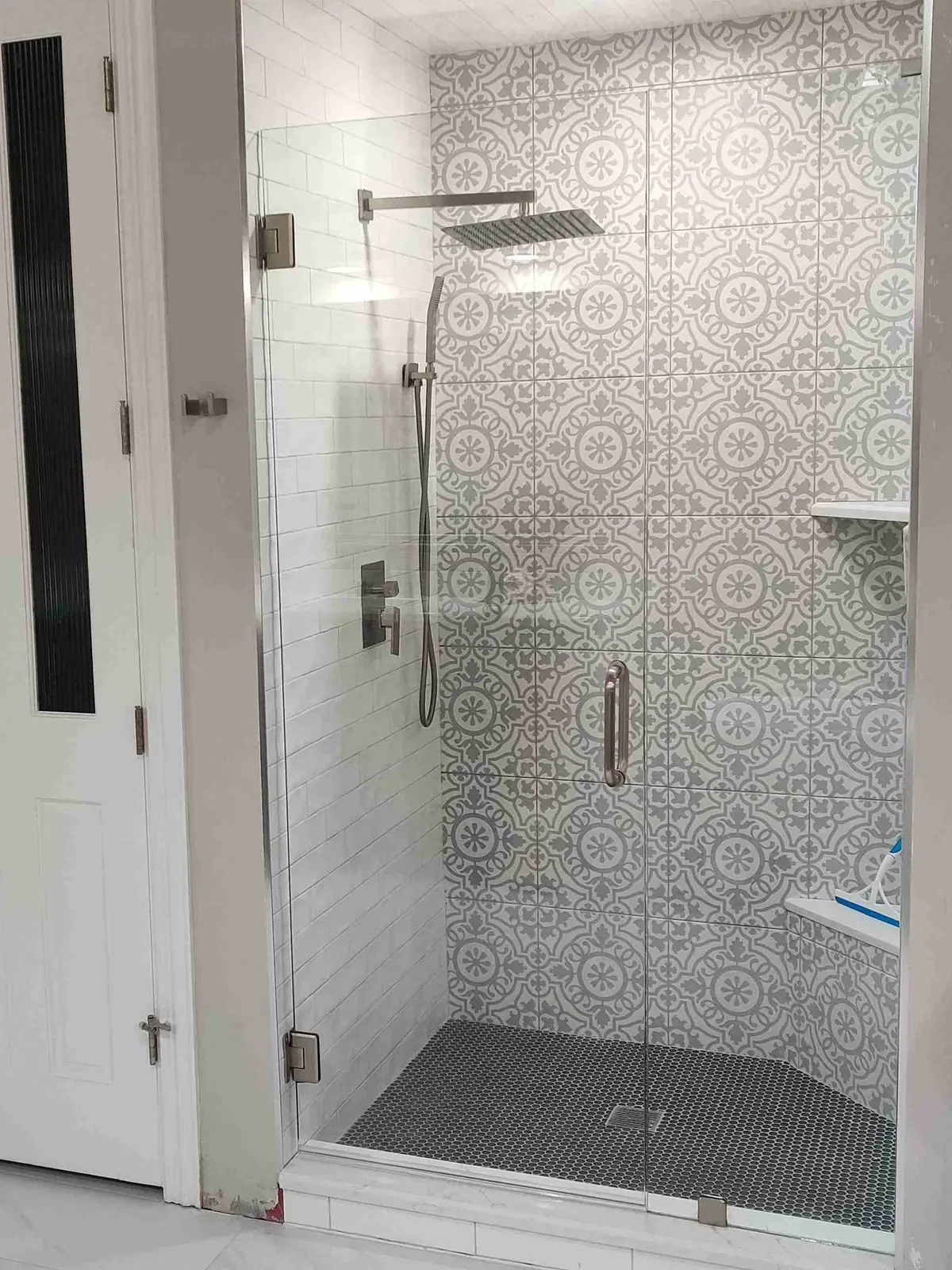
Tempered glass is the standard for shower doors. It is about four times as strong as ordinary annealed glass of the same thickness, and when it does break, the whole panel falls into small, cube-shaped pieces instead of long, sharp shards. It stays as clear as the glass it started from, and it usually costs less than laminated safety glass. It still needs careful handling and the right hardware. Here's what tempering changes, and what it doesn't.
Tempering changes how glass handles stress and how it breaks. It does not change the weight, the thickness or the color of the glass. Those differences matter more than the presence or absence of a frame, because a frameless door relies on the glass itself to stay rigid.
Tempered and laminated glass
Tempered and laminated glass are both safety glazing, but they are made differently. Tempered glass is a single sheet that has been heated and then cooled fast. Laminated glass is two or more sheets bonded to a plastic interlayer, so when it cracks, the pieces tend to stay stuck to the interlayer instead of falling out. Most frameless shower doors and panels are tempered glass.
Laminated glass shows up where keeping broken pieces in place matters most, such as overhead glazing, glass railings and storefronts. In a shower, tempered glass is the usual choice. A laminated panel has to be specified as a complete assembly with hardware made for it; it is not a direct substitute for every tempered shower panel.
Shower doors and enclosures are one of the places federal rules call for safety glazing. The Consumer Product Safety Commission's standard for architectural glazing, 16 CFR 1201, names shower doors and enclosures and sets impact tests the glass has to pass, and tempered glass is the usual way shower glass meets it. You can usually spot it by a small permanent mark etched or fired into one corner of the panel. Safety glass can still break and cause injury, so do not keep using a chipped or cracked panel; have a glass professional look at it.
How tempered glass breaks
Ordinary annealed glass cracks into long, sharp shards. Tempered glass breaks another way. Tempering leaves the outer surfaces squeezed in compression while the core is held in tension. When a hard knock or a chip gets through that outer layer, the stored stress lets go all at once and the whole panel breaks into small, cube-shaped pieces. Those pieces can still cut, so handle a broken panel with gloves and care. The same stress is why tempered glass can't be cut, drilled or notched afterward: every hinge hole, handle hole and notch has to be made before the glass is tempered.
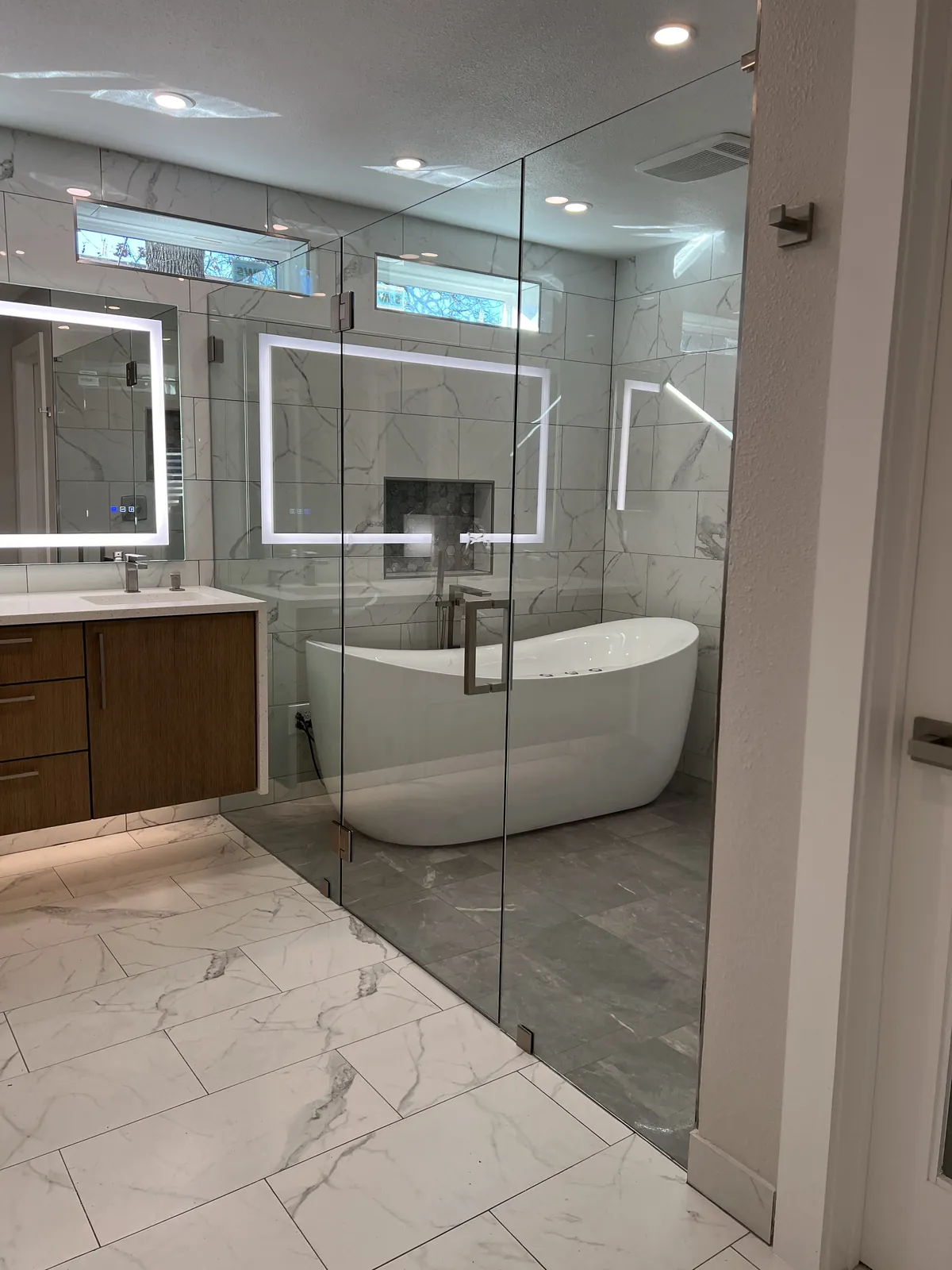
How much stronger is tempered glass?
Fully tempered glass is about four times as strong as annealed glass of the same thickness. To make it, the cut glass is heated close to its softening point, then its surfaces are cooled quickly with jets of air. The surfaces harden first and end up in compression. ASTM C1048, the U.S. specification for heat-treated flat glass, requires fully tempered glass to have a surface compression of at least 10,000 psi. That compression is what resists bending and impact, and it also helps the glass handle sudden temperature changes, like hot water hitting a cool panel.
Stronger does not mean break-proof. The edges are the most vulnerable part, so the glass should never rest directly on tile, stone or metal. Hinges, clamps and channels use gaskets and setting blocks to keep the glass off hard surfaces, and the enclosure still needs suitable hardware and careful installation. Once in a long while a tempered panel breaks with no obvious cause. That is usually traced to old edge damage or, rarely, to a tiny nickel sulfide stone inside the glass.
Optically clear appearance
Tempering doesn't change the color or clarity of the glass. Ordinary clear glass has a slight green tint that shows most along the edges, and low-iron glass reduces that tint. Compare samples if the look of the glass is a concern.
Reasonably priced
Tempered glass generally costs more than annealed glass and less than laminated glass of the same size, since laminated glass is two sheets bonded around an interlayer. Ask for the glass specification in the quote rather than choosing on price alone. Panel size, processing and the complete enclosure affect the cost.